
Saint Peter
Building profile
Historic/listed monument
Practical information


 © Églises Ouvertes
 © Églises Ouvertes
 © Églises Ouvertes
 © Églises Ouvertes
 © Églises Ouvertes
 © Églises Ouvertes
 © Églises Ouvertes
 © Églises Ouvertes
About this building
Kemmelberg, Monteberg, Rodeberg, Scherpenberg are all hills (bergs) surrounding Lokeren which provides one with a panoramic view of the church of which the most imposing part is the sturdy square tower topped by four small conical towers. The church was rebuilt in yellow brick in late Neo-Gothic style in 1924 by the architect A Dumon on the foundations of an old 15th century church. After the First World War, only the tower, which is protected, remained of this ancient church.
The interior of the church has three naves in white…
Kemmelberg, Monteberg, Rodeberg, Scherpenberg are all hills (bergs) surrounding Lokeren which provides one with a panoramic view of the church of which the most imposing part is the sturdy square tower topped by four small conical towers. The church was rebuilt in yellow brick in late Neo-Gothic style in 1924 by the architect A Dumon on the foundations of an old 15th century church. After the First World War, only the tower, which is protected, remained of this ancient church.
The interior of the church has three naves in white plaster and barrel vaults in wood. There is an 18th century bust of Saint Peter, a Pieta and numerous paintings among which are “The Last Supper”(1560), “the Nativity”( 17th century) and “the Adoration of the Magi” (17th century).
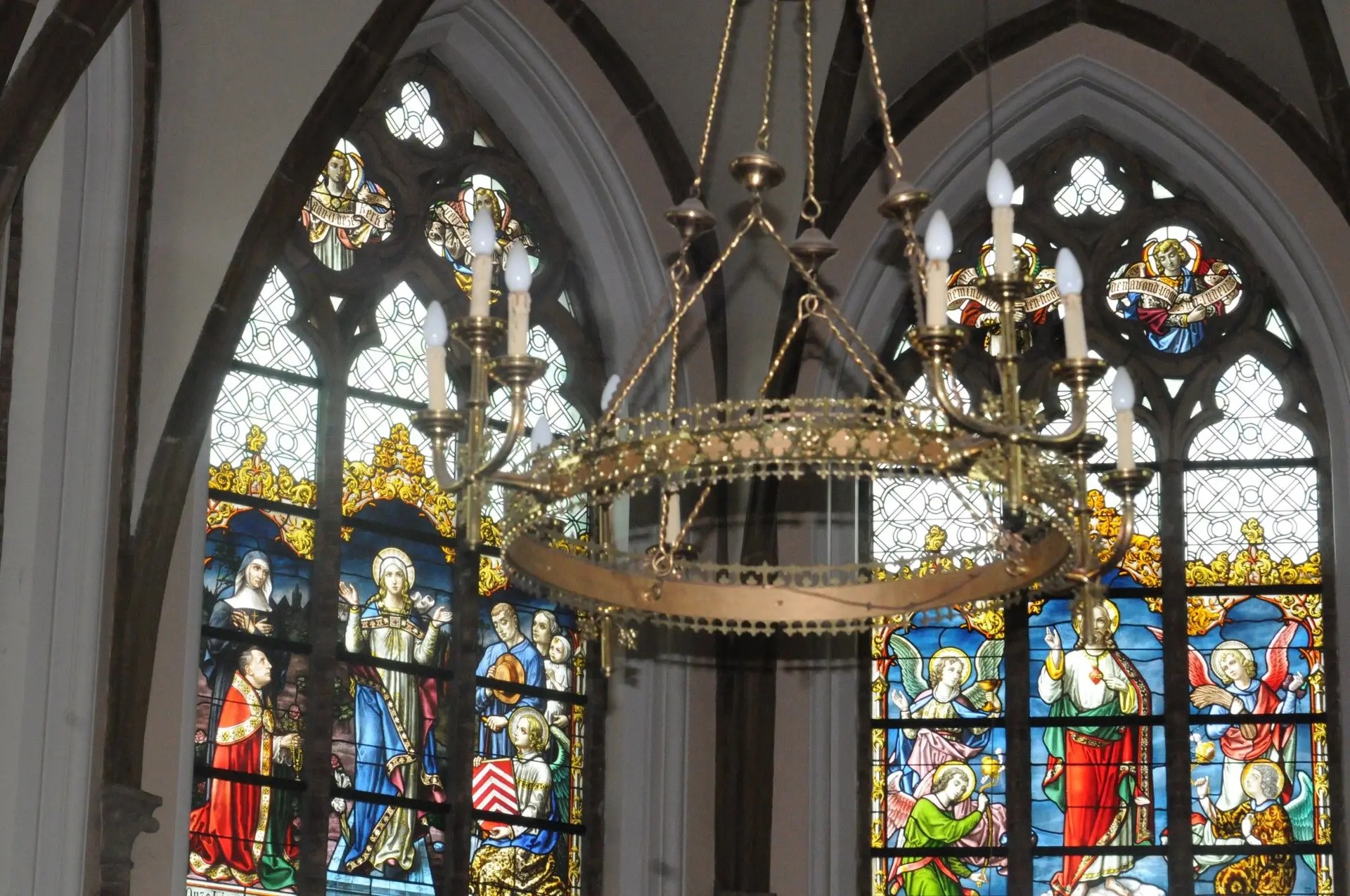
The stained glass window shows the murder of Charles the Good.
A new organ, placed in the church in 1913, disappeared in 1917. This was replaced in 1927 by the present one made by Jules Annessens.
Remarkable elements

Stained-glass windows
These 5 windows were made in the Bruges workshop of Wwe Justin Peene Delodder and installed in…
These 5 windows were made in the Bruges workshop of Wwe Justin Peene Delodder and installed in 1931.
Window 1: Our Lady of Lourdes with 6 soldiers: 3 seek her help before war; 3 wounded give thanks.
Window 2: Murder of Charles the Good on March 2, 1127, in St. Donatius, Bruges.
Window 3: Beatification of Charles the Good by Rome in 1882.
Window 4: Martyrdom of St. Peter, hanging head down from a cross. Together, these scenes reflect faith, war, martyrdom and devotion to Bruges' history and wars.

Last Supper
The frontshows Judas with money purse in the left hand (treason!). The painting, with a slight…
The frontshows Judas with money purse in the left hand (treason!). The painting, with a slight off-centre perspective, was made around 1560 in the “School of Ypres”.

Church door
The wooden door separating portal and church has nice carvings on the inside. The figures refer…
The wooden door separating portal and church has nice carvings on the inside. The figures refer to the Passion of Christ, a quiet meditation moment on the meaning of life.

Four Evangelists
This painting probably dates from early 18th century. At the top we see the dove, symbol of the…
This painting probably dates from early 18th century. At the top we see the dove, symbol of the Holy Spirit. Left is St. John with a book on his knees. Behind him most probably St. Luke, at the back St. Matthew and St. Marc with a lion at his feet.

Life in plenitude
Christ of San Damiano of Asissi surrounded by saints and local people tells us that Jesus gives…
Christ of San Damiano of Asissi surrounded by saints and local people tells us that Jesus gives us life in plenitude. It is a digital work of art, printed on photographic cloth, by Jef Vromant of Turnhout.

Stonemason marks
On the right outside wall of the tower we can detect red stonemason marks of the family de…
On the right outside wall of the tower we can detect red stonemason marks of the family de Hornes, lords of Loker. The same signs are also found on the church towers of Elverdinge, Boezinge en Rumbeke.
Labels

To find out more
Hours
Closed
Religious services
Kerknet
Nearby buildings



Comments (0)